
A few days ago we put the clocks back, and suddenly, at six in the evening, we can already see the sky darkening. It’s nippy in the morning, you don’t need a jacket at midday, and in the evening you fancy a blanket. And every year the same dilemma arises: should I switch the heating on now, or wait a bit longer?
It’s not just you. Winters have changed, and the way we heat our homes should change with them too.
We’ll explain how a smart home adjusts the heating to reflect what’s actually happening in each room, so you can stay comfortable without overheating.
Winter isn’t what it used to be
The AEMET estimates a 70% probability that the October to December quarter will be warmer than normal across most of Spain (in the south-west, around 60 per cent). The likelihood of it being colder stands at 10 per cent. And this comes hot on the heels of the hottest summer on record in Spain since at least 1869.
However, warmer than normal does not mean it won’t get cold. In practice, this means mild weeks interspersed with sudden cold snaps from one day to the next. Frosty mornings and mild afternoons. A spot in the sun that warms up quickly, and another in the shade that never quite warms up.
Why a fixed timetable isn’t enough
Back in September, we told you how to programme your home for getting back into a routine – for example, so that the heating switches on a little while before you get up. These programmes work very well when your days follow a set pattern.
The problem arises when it’s the weather that doesn’t follow a set pattern. A fixed schedule doesn’t know whether the sun has come up today, whether the living room is already at a comfortable temperature, or whether someone has opened the bedroom window to air the room. It switches on regardless.
And that ends up in one of two ways: heating a house that doesn’t need it, or, quite simply, heating the street. That’s why the key this winter isn’t just about setting a schedule, but ensuring your home reacts to what’s actually happening.
A house that reacts to what’s going on
Every room at its own temperature
Not every room has the same needs. The south-facing living room only really gets warm at midday. The north-facing bedroom stays cold all afternoon. And the study is only used in the mornings.
The IDAE itself explains this in its Practical Energy Guide: a home’s heating requirements change throughout the day and from one day to the next, and not every room needs the same level of heat.
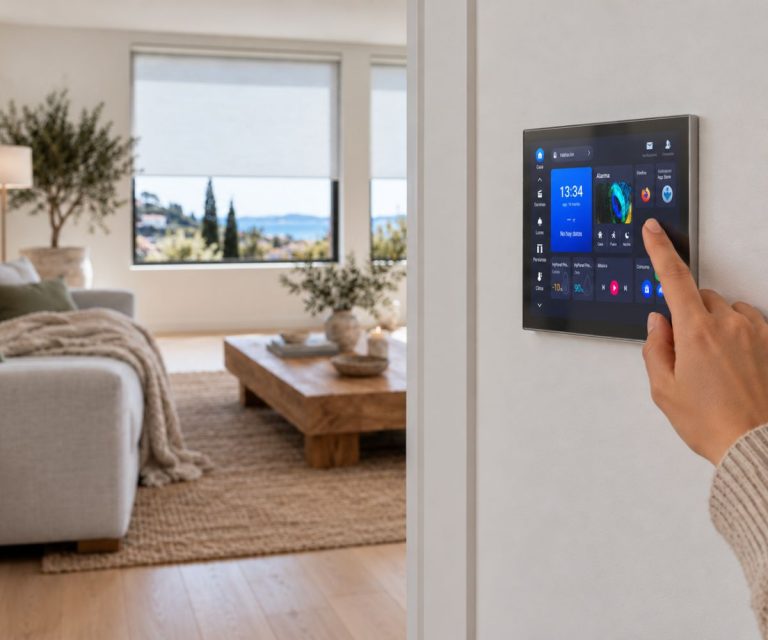
With a smart home, each room has its own temperature and the heating only operates where it’s needed. It doesn’t matter what system you have: we integrate all types of heating, provided they’re compatible with the system, so you can control them from a single app, via a wall-mounted panel or using your voice assistant.
You can find more details on our climate page.
If you open a window, the heating switches off
Ventilating in winter is still necessary. What doesn’t make sense is leaving the heating on whilst the window is open.
With a sensor on the window, you can set it up so that the house knows as soon as you open it and turns off the heating in that room. When you close it, the temperature returns to normal automatically. It’s one of those automated systems that you set up once and then never have to think about again.
Blinds also trap heat
Roller blinds are one of the most effective ways of retaining heat. According to their guide, between 25 and 30 per cent of our heating requirements are due to heat lost through windows. That is why one of their heating tips is to close roller blinds and curtains at night to prevent heat loss.
With motorised blinds, you can programme them to raise in the morning to let the sun in, and to lower automatically at dusk to prevent heat from escaping – without having to go from window to window.

It all works together
The best part comes when all this works together. In the morning, the living room blinds are raised and the sun streams in. The room warms up and the heating in that area no longer needs to work so hard. At dusk, the blinds are lowered and the house retains that warmth.
This is what we told you: a smart home is an ecosystem that manages more than just connected devices.
A cosy home, whatever the weather
This winter will bring mild days and cold snaps. What doesn’t have to change is how comfortable you are at home.
At Kimbo Smart, we assess your home, integrate your heating into the system and get everything up and running using our own equipment. It’s wireless, adapts to every home and can be expanded whenever you like. And there are no monthly fees.
Would you like to know what we could do for your home? Request a quote and we’ll let you know.
FAQs
That’s not necessarily the case. We can integrate any type of heating system, provided it’s compatible with the system. We’ll go through this with you during the survey of your home.
Yes. You can view and adjust the heating via the app, wherever you are.
It’s no problem. The heating is also controlled via a wall-mounted panel or by voice, and lots of things happen automatically, without anyone having to touch a thing.
Yes. As it’s a wireless system, it can be installed without laying any new cables and without disrupting your daily routine.
Heating only the rooms you use, not heating with the window open and making the most of the sun really makes a difference. How much of a difference depends on each house and how you use it.