
More and more older people want to continue living in their own homes for as long as possible. That’s where they have their routines, their independence and their own way of doing things.
Technology can help ensure that this remains the case. A smart home for older people can make certain tasks easier, alert you if anything happens in the home and allow you to lend a hand remotely when needed.
The idea is not to change the way they live, but to ensure that the home adapts a little more to their needs, so that everyone can have greater peace of mind.
Living alone whilst feeling accompanied
Living alone is becoming increasingly common. According to the INE, there are already more than 5.4 million single-person households in Spain, and this figure is forecast to rise to 7.7 million by 2039.
Furthermore, more than two million people aged over 65 live alone, according to Amigos de los Mayores.
For many people, continuing to live in their own home means maintaining their routines, their surroundings and their independence. And when the home is suitable, that independence can be even more comfortable.
What a smart home can do in everyday life
1. Flood sensors: detect the problem before it gets out of hand
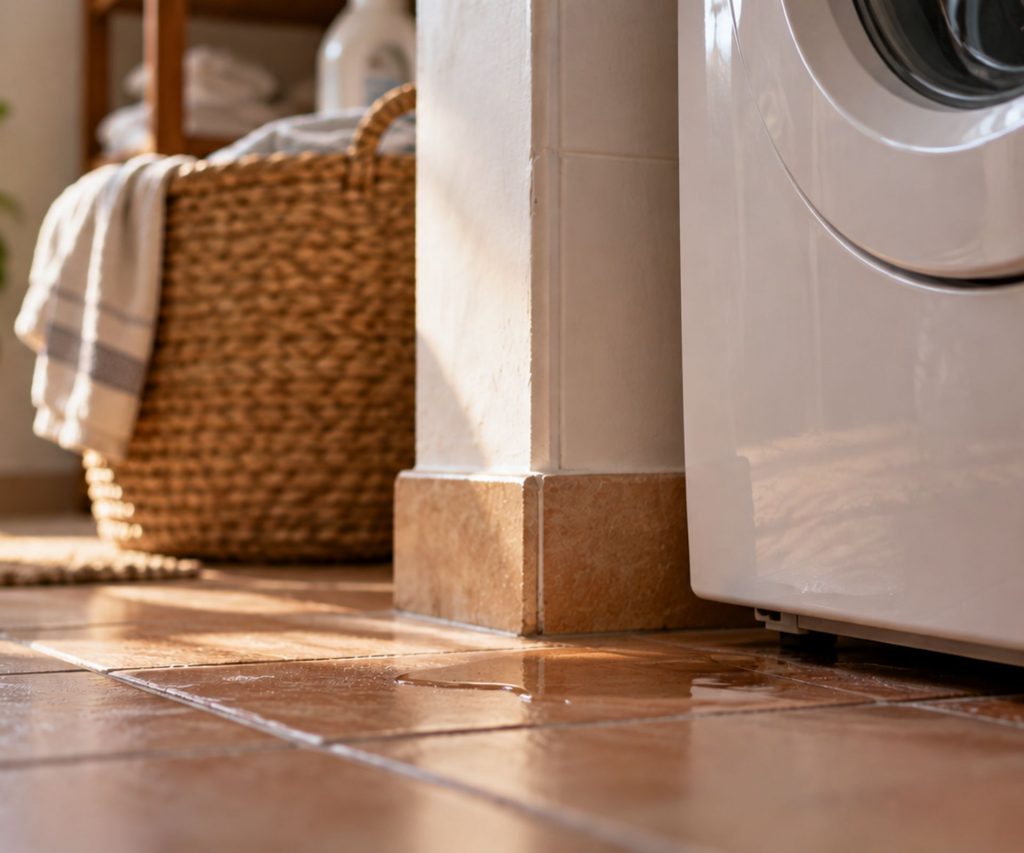
A leak can occur at any time: a washing machine, a water heater, a sink or any other water installation can cause a problem.
A flood sensor detects water on the floor and sends an immediate alert: to your mobile phone and, if you choose, also to a family member or trusted neighbour who can come and check.
And with a shut-off valve, the water is
It locks without anyone having to bend down to look for the stop valve, which is always in the most awkward spot in the house.
This is no minor detail: as we explained in our article on how a smart home looks after itself in August, water damage is the most common claim under home insurance policies.
2. Smart lock: making access easier when needed
With a smart lock, you can manage access to your home without relying solely on physical copies of keys.
You can grant access to family members, trusted individuals or professionals who need to enter at specific times, and revoke that access when it is no longer required.
Furthermore, the door can still be used as normal, so there is no need for those living in the house to change their routines.
You can find out more about this solution on our access control page.
3. Remote climate control: the house is always at a comfortable temperature
Being able to maintain a comfortable temperature without having to constantly keep an eye on the heating and cooling system can make everyday life much easier.
When the heating and cooling system can be integrated into the home, it adapts to your routines: warm before you get up in winter, cool at siesta time in summer, without you having to remember to switch anything on or look for the remote control.
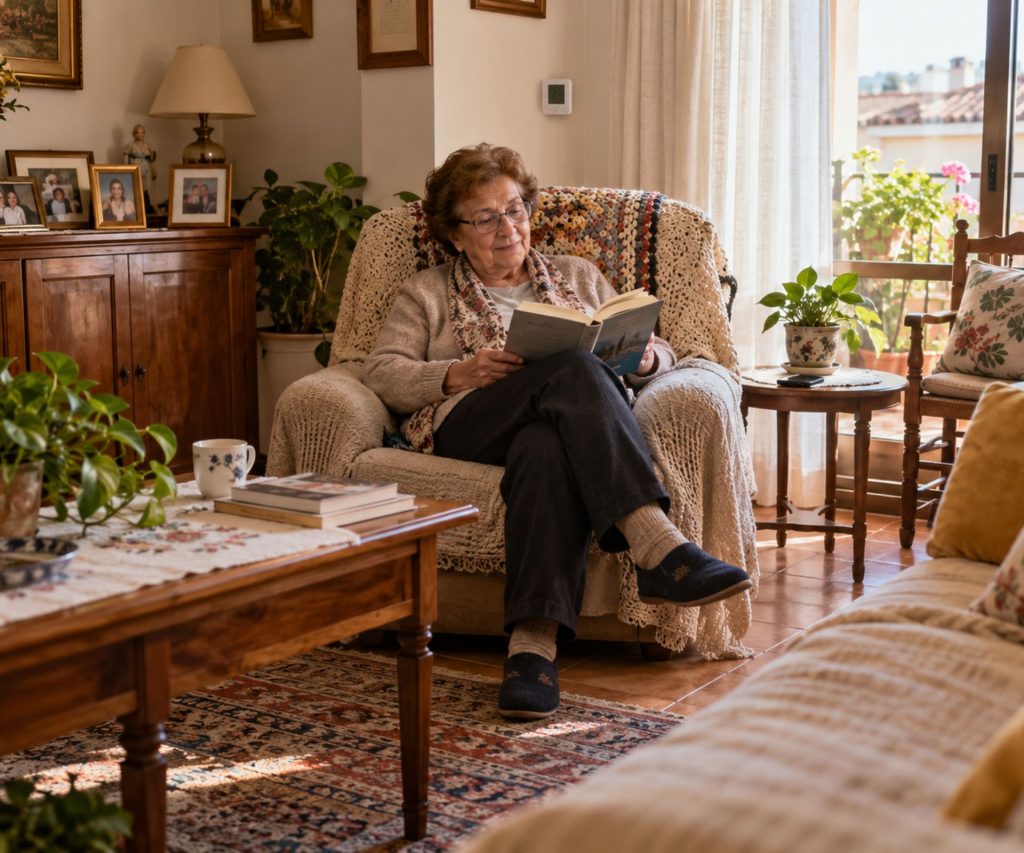
You can also check and adjust the temperature from your mobile, whether you’re at home or out and about. And if you’d prefer someone to give you a hand one day, an authorised family member can do so remotely.
You can find out more in our article on smart climate control and on our climate page.
4. Touchscreen, switches or voice control: everyone can control their home however they prefer
A smart home shouldn’t force anyone to change the way they do things, whatever their age. That’s why there’s no need to rely on your mobile.
Traditional light switches still work just as they always have. Anyone who wants to can use a touchscreen panel to control the lights, blinds and air conditioning from a single location, or simply ask the house to do it using their voice whilst sitting on the sofa. And the mobile is there for those who prefer it.
What’s more, some things can be done automatically: the blinds can be set to go up at the time you get up, or the hall light can come on when it starts to get dark. These are small, everyday tasks that the house takes care of without anyone having to think about them.
The key is that the technology adapts to your habits, not the other way round.
5. Motion sensors: a light to help you get up at night without tripping

Getting up in the early hours of the morning to go to the toilet or have a glass of water is perfectly normal. What you should avoid is doing so in the dark, fumbling around for the light switch.
Thanks to a motion sensor, the light switches on automatically as soon as you set foot on the floor, lighting your way from the bedroom to the bathroom. At night, it glows dimly – just enough to see clearly without disturbing your sleep – and
switches off automatically a few minutes later.
According to the World Health Organisation, between 28% and 35% of people over the age of 65 suffer a fall every year. Many of these occur at home and during everyday moments such as this. A light that comes on just when you need it is a small gesture, but it helps.
6. Buttons: just one click for everyday tasks
There are daily tasks that require you to move from one room to another: switching off lights, lowering the blinds, checking that everything is in order before going to bed.
A wireless button brings them all together with a single click. It can be placed wherever is most convenient, and each button can be assigned a different function:
On the bedside table, a ‘goodnight’ button that switches off the lights throughout the house and lowers the blinds. In the hall, a ‘I’m off’ button that ensures everything is switched off when you leave.
If you prefer, a button can also send a notification to a family member’s mobile asking them to call you. This is a simple way of asking someone to get in touch.
As they’re wireless, they can be mounted on the wall or placed on a piece of furniture, and moved to a different spot if, over time, it becomes more practical to have them elsewhere.
7. Smoke detectors and smart sockets: fewer oversights, greater peace of mind
The stove left on, the brazier under the coffee table, the iron left plugged in. We all have a moment of absent-mindedness now and then, and at home, some of these can have serious consequences.
A connected smoke detector doesn’t just sound an alarm inside the home: it also sends a notification to your mobile, just like the flood sensor. That way, even if nobody hears it at the time, someone in the family will be alerted.
Smart plugs allow you to switch off the power to an appliance at a specific time or by pressing the ‘I’m leaving’ button on the front panel. A heater that switches itself off at night is one less thing for everyone to worry about.
A smart home without any building work or major changes
A home does not need to be completely transformed to incorporate this sort of solution.
There is still a perception that installing technology at home involves breaking through walls, adding wiring or altering the entire electrical system.
With the wireless solutions we work with at Kimbo Smart, many features can be incorporated without the need for building work or additional cabling.
The installation is tailored to the existing home and is also modular.
This means you don’t have to do everything all at once.
You can start with the features you find most useful and expand the system later on.
Their home, Their rules
When incorporating solutions of this kind into an older person’s home, one thing is particularly important: they must continue to feel that their home functions as it always has.
Every installation should be tailored to their routines and to what is genuinely useful to them.
It is not about filling the home with devices or constantly monitoring what is happening inside.
In fact, in many cases, there is no point in installing indoor cameras either.
The idea is much simpler: that the home should provide support when needed, without intruding on day-to-day life.
That each person can continue to live in their own home in their own way, with a little more comfort and peace of mind.
If you’re thinking about adapting a property, tell us about the house and what you need, and we’ll help you assess which solutions might be best suited to your needs.

FAQs
No. You can still use standard switches, a touch panel or even voice control. What’s more, many functions can be automated so that you don’t have to do anything.
To control your home remotely and receive alerts on your mobile, yes. Some local functions may still work offline, depending on how the system is set up.
Yes. As they use wireless technology, many solutions can be installed in existing homes without the need for building work or new wiring.
No. You can start with just a few features and expand the system later as required.